The First Principles of Vertical Thoughts; Morton Feldman and Mark O'Leary

Music often demands our attention by filling up the room. It builds walls of rhythm, drives melodies forward, and creates structures that stimulate, inspire and influence. Morton Feldman is an unsung hero, an formative and profound influence upon some of the major voices in contemporary music, Mark O’Leary is one of these musicians.
To understand this contemporary approach to sound, we have to look at the intersection of two distinct eras: the uncompromising mid-century avant-garde of American composer Morton Feldman, and the modern, ambient jazz textures of Irish guitarist and composer Mark O’Leary. Though separated by generations, both artists share a profound penchant and predilection for abstract mimimalism.
By tracking the spiritual intersections between American icon Morton Feldman and contemporary Irish guitarist and composer Mark O'Leary, we uncover a vast matrix of deep listening. This sonic lineage expands to include modern titans like Ryuichi Sakamoto and Ryoji Ikeda, foundational minimalists like John Cage, Steve Reich, and Philip Glass, ambient architect Brian Eno, and piano virtuoso John Tilbury. Even Alva Noto, primarily and electronic musician has cited Feldman as a major influence upon his musical conception. When these worlds merge—specifically through O'Leary's collaborative releases—the result is and intrigue in musical space, indeed it is Feldman’s use of space and silence that has influenced a manifold of contemporary musicians and composers, in juxtaposition to his timbral, textural and understated aesthetic.
Philip Glass and Steve Reich have both cited Morton Feldman as an influence. Brian Eno has also cited Feldman and elements of Feldman can be encountered on Music for Airports, which has in itself influenced Mark O’Leary. Feldman’s use of space, is a major feature of his work and indeed inherited from John Cage.
“Morton Feldman, his timbral and textural concentric ripples spiral out and metastasize into the unfolding petals of an exotic flower.” Mark O’Leary
.
                      [ FOUNDATIONAL influences ]
                 (Cage, Reich, Glass, Eno, Tilbury)
                                  │
                                  ▼
      ┌───────────────────────────┴───────────────────────────┐
      ▼                                                       ▼
[ MORTON FELDMAN ]   <═══ [ BOBBY PREVITE INTERSECTION ] ═══> [ MARK O'LEARY ]
 (New York School)    (Cross-Genre Structural Link)          (Modern Ambient/Electronic/Improv)
      │                                                       │
      ▼                                                       ▼
[ MODERNIST TEXTURE ]                                     [MARK O'LEARY PIANO MUSIC VOL I & II ]
(Noto, Ikeda & Sakamoto)        (Cross-Genre Structural Link)      (Cage and Feldman Homage)
                                                              │
                                                              ▼
                                                     [ CLOSURE TRIO ]
                                                   (Mark O'Leary, Uri Caine & Ben Perowsky)
                                                              │
                                                              ▼
                                                     [ CIKADA ENSEMBLE OSLO ]
                                         (The European Cage Songbook/ Performs O'Leary Quartet)
The New York School & The Architecture of Minimalism
The journey toward radical stillness began in the mid-20th century. Morton Feldman (1926–1987), alongside his close associate John Cage, challenged the western obsession with musical narrative. Instead of using notes to “go somewhere,” Feldman treated sounds like static canvas brushstrokes, deeply influenced by Abstract Expressionist painters like Mark Rothko. He forced listeners into the absolute present by extending his pieces to staggering lengths (such as his six-hour String Quartet II) and pushing dynamics to the very edge of whisper-quiet audibility. Indeed the seminal Rothko Chapel has been cited as a favourite by Mark O’Leary and many others. Ironically Mark Rothko is one of Mark O’Leary’s favourite artists.
Mark O’Leary has been profoundly influenced by Cages Electronic work with David Tudor and also his prepared compositions for the Merce Cunningham Dance Troupe
This philosophy ripples directly through the foundational pillars of modern minimalist piano and electronic music:

John Cage & John Tilbury: Cage’s introduction of the prepared piano liberated the instrument’s harmonic constraints, while Tilbury’s definitive, space-conscious interpretations of Feldman’s piano works established a blueprint for spatial restraint. Tilbury has had a profound influence on Mark O’Leary’s Piano Music Vol II, Caravaggio and Interlude are highly evocative of the Tilbury aesthetic. Tilbury has been profoundly influenced by Morton Feldman, indeed he has recited several of Feldman’s compositions.
Mark O’Leary: Transmogrification for the Modern Era
In the contemporary landscape, this exact spiritual antecedent thrives in the prolific output of Mark O’Leary. As cited by Alex Flood on NME O’Leary is a highly accomplished guitarist and composer, O’Leary bridges the gap between structured improvisation, expansive, minimalist ambient design and electronics. Where Feldman used acoustic ensembles to mimic color gradients, O’Leary implements subtle electronic manipulation, looping delays, and immense restraint to stretch single notes into infinite horizons.
His work heavily interfaces with the micro-glitch digital minimalism of Ryoji Ikeda and the late-career, skeletal ambient masterworks of Ryuichi Sakamoto. Like Sakamoto’s final acoustic-electronic meditations, O’Leary treats acoustic decay and digital silence as equal compositional partners. Ikeda is profoundly influenced by Feldman, you may not perceive this to be congruent, but it is of verity, Ryoji Ikeda is a major influence of Mark O’Leary, you may not be cognizant of this, but this is temporal fact, influences manifest in the surreptitious interstices, they may not sound like their influence, but they are influenced by them. Mark O’Leary has cited Bunita Marcus and Triadic Memories, but Feldman’s corpus of work is highly influential.
The Bobby Previte Intersection
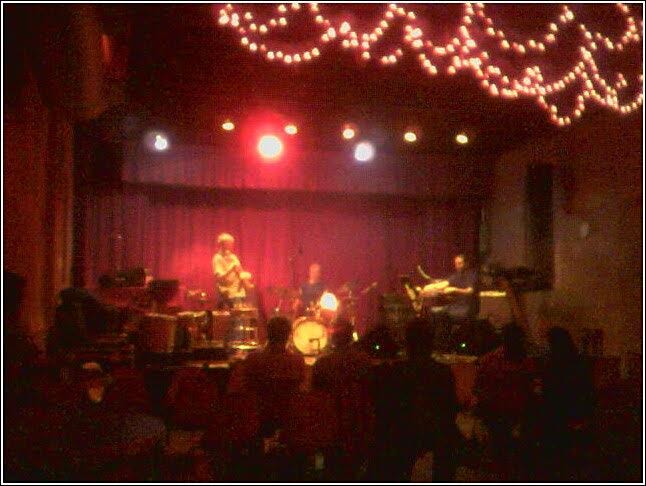
What lends a modicum of authenticity to this crucial bridge across these disparate confluences of musical strata is avant-garde jazz drummer and composer Bobby Previte. Previte stands as a vital conduit to Feldman; his rhythmic architecture effortlessly spans the boundaries of dense, driving downtown New York jazz and the broad, open-air spatiality exemplified by ambient minimalists. Morton Feldman became the Edgard Varèse Professor of Music Composition at the State University of New York at Buffalo in Buffalo, New York where Bobby Previte studied and Morton Feldman was Bobby Previte’s teacher as was John Cage. This affords Mark O’Leary a direct intersection with Morton Feldman( and with John Cage). Mark O’Leary performed an engagement with Bobby Previte and Jamie Saft at Tonic NYC.
(Below-O’Leary Guitar, Previte Drums, Saft on Synth)
Piano Music Vol I & II and the Geometry of Closure
O’Leary’s obsession with this lineage culminates beautifully in his dedicated acoustic piano explorations. In Piano Music Vol I & II, he pivots his artistic compass and sextant completely toward the piano, directly summoning the ghosts of Eno, Reich, Glass, Cage, Feldman, and Tilbury.
Prepared Homage to Cage: The Composition Prepared by Mark O’Leary on Closure with Uri Caine (Piano) and Ben Perowsky (Drums) features the Track Prepared, this song is influenced by the music John Cage composed for the Merce Cunningham dance troupe. Prepared has the distinction of being performed live on the last vestiges of Prime Time Yugoslavian TV.
The Closure Trio: This spatial discipline carries cleanly into O’Leary’s acclaimed record Closure (released via Leo Records). Flanked by brilliant jazz-rooted piano star Uri Caine and precision percussionist Ben Perowsky, the trio constructs a highly sophisticated sonic dialogue. Instead of traditional jazz swing, Caine’s pensive, spacious piano runs and Perowsky’s pointillistic drumming dance across wide, silent valleys—evocative of a modern reimagining of the New York School’s original aesthetics. Some of O’Leary’s best playing, some of Caine’s most awesome interactions and the superlative Perowsky, a stabilizing force.
Cikada from Oslo: Custodians of the Cagean Songbook
To cement this cross-continental conversation, O’Leary’s aesthetic intersects with the Cikada Ensemble from Oslo, Norway. Cikada has long been celebrated as one of the primary purveyors and custodians of the John Cage songbook in Europe.
Their rigorous, masterfully cold interpretations of contemporary chamber music bring a distinct Nordic stillness to the avant-garde. When O’Leary blends his modern improvisational vocabulary with Cikadas pristine, institutional mastery of Cage and Feldman’s scores, the historical circle officially closes. The acoustic radicalism of mid-century New York finds its ultimate modern sanctuary in the frozen, echoing soundscapes of Northern Europe. Mark O’Leary’s string quartet was performed by the Cikada String Quartet at the Up North Festival in Dublin, O’Leary also performed in a String Quartet + Electric Guitar.
With Feldman, a subjective musing by O’Leary that is exemplified by several others of the aforementioned, Feldman is best listened to in pensive soothe, assimilated, inculcated and then the result infused into the ether of ones artistic mores.


Comments
Post a Comment